http://www.thespec.com/news-story/4390870-burlington-transit-releasing-june-report-card/
Feb 28, 2014
Burlington Transit releasing June report card
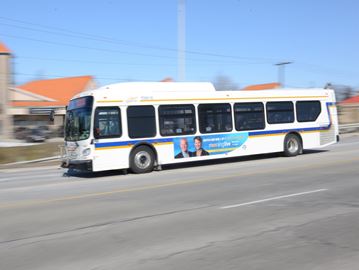
Burlington Transit will be presenting a
six-month report card to councillors in June about the impact of the
changes to the city’s bus system that took effect Nov. 3, 2013.
The news came during a transit update
presented last week to the Community and Corporate Services Committee
during the first day of budget deliberations.
The report card will be based on transit performance indicators.
“We’re here to build a solid, reliable
transit service,” said Mike Spicer, transit director. “We want to base
it upon the rider experience, because without the rider making that
experience positive, we’re not going to succeed. We need to also
continue to ensure our buses can be utilized in the most efficient and
cost-effective manner.”
Burlington Transit has documented
approximately 270 concerns in November and December 2013 in relation to
the service changes that were implemented last fall.
Among the top concerns were longer
commutes/wait times (50 complaints), Route 10/20 transfer (38),
dissatisfaction with changes (28), buses not entering Mapleview Centre
property (14) and difficulty reading the new Ride Guide (11).
Spicer said based on a monthly ridership of
approximately 175,000, the complaints came from approximately 0.7 per
cent of transit users.
The transit director said there was also
positive feedback, including Route 15 has better service (15 comments),
better connections on Route 21 (14), better connections at Burlington GO
and Appleby GO stations (18) and great service on Route 48 (14
comments).
The latest transit report did not sit well with delegates who addressed committee last week.
Susan Lewis, a Ward 3 resident, said she was
concerned about the volume of complaints made to Burlington Transit
since the Nov. 3 service changes.
“With about 300 complaints in the first two
months, there’s obviously a huge problem occurring in the here and now,”
she said. “To address it sometime in the future while allowing all
these problems to fester is only going to add to the growing frustration
that I’m seeing on the street.”
Doug Brown, chair of Burlington for
Accessible Sustainable Transit, labelled the Nov. 3 changes a ‘rob Peter
to pay Paul’ situation.
“In the case of the interim service plan,
Peter turned out to be the northeast Burlington, Paul turned out to be
the Fairview corridor,” he said. “We really need to consider everybody.
This transit system needs to serve the whole community.”
Ward 5 resident James Smith went one step
further, suggesting the city issue a request for proposals (RFP) for a
new transit provider.
“I honestly think that perhaps council
should consider giving up on transit – that we should take the money
that we do now, put out an RFP, have Oakville Transit, Hamilton Street
Railway, Metrolinx, somebody, a private individual, take up the slack…,”
he said.
Spicer said the changes made to the transit system on Nov. 3 were appropriate.
He pointed out boardings per hour have
increased since the changes took effect in comparison to January-October
2013, specifically identifying growth in boardings per hour on Routes
10, 101, 1, 6, 4 and 15.
The bar graph chart comparing
November-December 2013 and January-October 2013 data on Routes 10, 101,
1, 4 and 15 shows increases of approximately 1-5 boardings per hour
since the changes came into effect.
He added new Route 48 Millcroft, which
provides weekday morning and afternoon service between Corpus Christi
and Frank J. Hayden secondary schools, is very successful with close to
50 boardings per hour.
Spicer said last month saw the boardings per hour grow further on a number of routes.
“We needed to take our baseline service and
we needed to create a network that gives us solid base service so we
can provide growth from there and we think we’ve accomplished that with
the changes we’ve implemented in November,” he said. “Now our growth
strategy will come and our growth strategy will be an aggressive plan on
how we are going to improve the modal split... There will be a business
plan in order to support that growth.”
Spicer said the Canadian average for
municipal public transit has a revenue-cost ratio of 55 per cent, with
the average municipal operating cost per capita at $105.69.
Provincially, revenue to cost ratio is 63 per cent, with a municipal
contribution of $92.21 per capita for public transit.
In 2012, Burlington operated 51 buses, had a
revenue-cost ratio of 39 per cent and a municipal operating cost per
capita of $43.17.
That same year, Oakville operated 90 buses
with a revenue-cost ratio of 34 per cent and a municipal operating cost
per capita of $71.95.
The next steps for Burlington Transit are
connecting Routes 10 and 20 to remove the need to transfer, working with
DeGroote School of Business on a survey about possible changes to
Routes 10/20/40, negotiating with Mapleview Centre for bus priority and
preparing a growth strategy to increase service to under-utilized,
low-performing areas.
Burlington Transit is also implementing
smart bus technology, which will give riders up-to-the minute
information about the city’s transit system, this year.
The transit report that went before
committee last week included two options, but no recommendations, for
transit service changes.
Scenario A was an increase in frequencies
during off-peak service hours at a cost of $693,003, which includes
$481,528 for annual human resources costs for operators and $211,475 in
annual operating cost.
Scenario B for an increase in overall
service including frequencies and routes was also presented at a net
cost of $2,858,530, including $1,084,592 annual human resources costs
for operators, $548,938 in annual operating costs, $1, 470,000 in
capital costs for bus purchases. Annual revenue is expected to be
$245,000.
Neither Option A nor B was put on the table by councillors at last week’s meeting.
Mayor Rick Goldring responded higher
investment in the system isn’t necessarily the answer, adding he wanted
to see the transit report card results in June before making any
changes.
“We’re trying to do the best and create the
best transit program for the dollar investment…,” said Goldring.
"Oakville spends over twice as much as we do
in Burlington on transit and they only had 25 per cent additional
ridership. Is that a good investment? I think we’ll have that discussion
further after the six-month report. Very clearly we have to give this
new system the opportunity to be measured effectively and we have to
give people who may have been inconvenienced somewhat time to get used
to the new changes.”
During last Thursday’s deliberations, Ward 2
Councillor Marianne Meed Ward proposed altering Route 5
Francis-Downtown to return service along Ontario Street.
The motion failed 6-1, with Meed Ward the
lone vote in support. Some of her colleagues around the table suggested
they’d like to see the June transit results before making any route
changes at this point.
The next, and likely final, day of budget
deliberations on Tuesday, March 3 includes a budget amendment proposed
by Meed Ward that the John Street Terminal in downtown Burlington not be
closed. Closing the terminal is proposed in the 2014 budget to cut
$8,060 from transit’s base budget.
(3) Comments
The recent changes were made by
someone who never uses the bus. A requirement for making the schedules
& routes should be that the person give up their car for a month. I
bet they won't last a week with the current routes & times. There
should not be half hour service in the winter. It takes 2 or more buses
now to get any where and the transfers miss each other by minutes so
you have to stand in the cold for 25 minutes. There is hardly any
service in the downtown area. Buses don't meet at the Go station or the
terminal. I used to ride the buses 2 or 3 times a week but now only
once out of necessity. Definitely not a service for seniors!
Flawed system. Waste of taxpayer
money. Fix the mistake -- scrap BT now! Burlington DOES NOT NEED a
public transit system that NO ONE uses.
The recent changes were poorly
communicated and poorly thought through. Removing the buses from inside
the Mapleview lot is a disaster for seniors. The transit route changes
have meant that several people I know no longer use transit. However,
staff and council move glacially to rectify the problem - because none
of them rely on the service.

No comments:
Post a Comment